 |
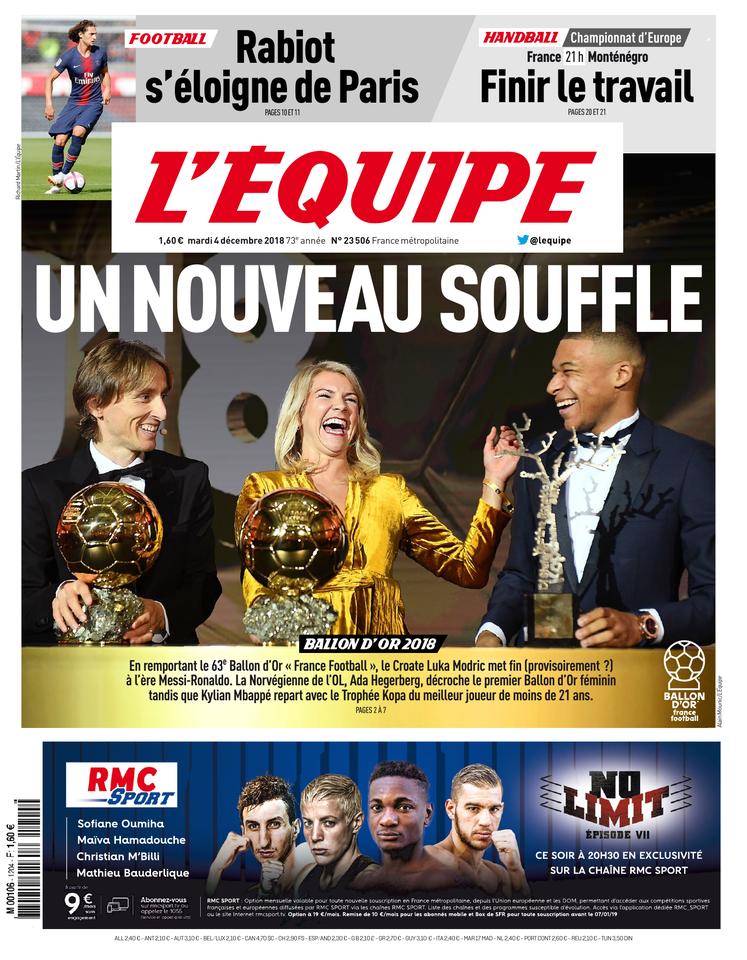
| The day after the Ballon d'Or awards, from the front cover of L'Equipe. 'A new breath', it says, a reference to how not since 2007 the men's winner has gone to someone not call Cristiano Ronaldo or Lionel Messi with how Croatia and Real Madrid's Luka Modric (left) winning it, Lyon's Norwegian striker Ada Hegerberg (centre) getting the inaugural female Ballon d'Or, Kylian Mbappe (right) getting the inaugural Kopa Trophy or the junior Ballon d'Or. (Image via here.) |
But then in the modern times, it has also come to be seen as a justification of which football club is the best in the world to the extent or the pride of a nation when one of its representatives has won it, or at least how the Spanish media is still upset that Michael Owen won it ahead of Raul back in 2001. The Spaniards can be considered ahead in terms of using the Ballon d'Or as that form of justification, because the former Barcelona striker Luis Suarez (no, not the current one!) is still the last Spaniard to win it in 1960, and the last time Spain had a real big debate over who should be winning it amongst their own, it came in the same year they won the World Cup in 2014. Even in a country that used to be divided over the eternal debate of who is the best in Cristiano Ronaldo and Lionel Messi until the former went to Juventus back in the summer, it still rankles that it has been that long since one of their own won it. The original Suarez won it during a time before he was to be known one of the Spaniards who also made it in Italy, when he was to be later part of Helenio Herrera’s Inter, after Herrera was already his manager at Barcelona.
Luis Suárez Miramontes, un futbolista incomparable. #ElDíaDespués pic.twitter.com/L9jP4NRg3H— El Día Después en Movistar+ (@ElDiaDespues) October 22, 2018
(The original Luis Suarez, back in the day. Still the last Spaniard to win the Ballon d'Or back in 1960, by the way. And the video which came ahead two of his former clubs play each other in the Champions League group stages in Barcelona and Inter Milan.)
Then again, we have come a long way not since when Michael Owen used to say in an interview with France Football magazine that he only knew he had won it when his then-Liverpool manager Gerard Houllier, a Frenchman himself, told him about it before a Champions League match. In hindsight Owen is still the last English footballer to do it back in 2001, considering the inaugural winner in 1956 was also an Englishman in the late Stanley Matthews. When Kevin Keegan won it twice in a row in 1978 and 1979, it was also notable for how it was achieved when he was at Hamburg, to do it at a football club outside of the English game. In a way, what Keegan did is also still seen as the pinnacle, representing the best of what the English game can be outside of its territory too.
Owen : «J'avais envie de crier sur tous les toits : "je suis Ballon d'Or!"» https://t.co/5pQdgB39wb pic.twitter.com/6AIrWE9s0W— france football (@francefootball) October 25, 2016
(In the same week when the nomination list for the 2016 Ballon d'Or came about, excerpts of the Michael Owen interview in France Football and how he knew he won the 2001 edition. And it took a while since then for the English game to try make it a big deal like their counterparts elsewhere.)
Over the years or at least in the current times, it is well known that a few factors are always at play in the Ballon d'Or stakes. The eternal debate of whether using the calendar year as the benchmark is justified because it always comprises of two half-seasons. It is not just the domestic season, there is also the Champions League. And if it coincides with major international tournaments like the World Cup or the European Championships, that is also being factored in as well. Though one may say that the last person to win it was Fabio Cannavaro in 2006, the same year Italy won the World Cup. When Spain did it in 2010, it turns out the vote for the Spanish players involved at the tournament had been split. And only Germany goalkeeper Manuel Neuer made it to the top 3 in 2014, the same year Germany won the World Cup. Even that was a big deal, because that was the last time there was quite a debate of whether a goalkeeper would end the drought not since Lev Yashin won it in 1963, where the importance of that just keeps increasing each time no goalkeeper made it to the top three of the vote.
The last French Ballon d'Or winner came in 1998, the same year France won the World Cup. There was also a caveat that Zinedine Zidane, still the last French winner in this, was playing at Juventus at club level when he won it. Seven years before in 1991, Marseille striker Jean-Pierre Papin did it while playing for the club, two years before the club won the European Cup...but without him at the heart of it. So it does make one wonder why for Antoine Grizemann, he has always been adamant that being a World Cup winner merited a chance at winning the Ballon d'Or, back when he had his media 'campaign' to lobby for his chances, and he came in third after all the 'campaigning'. True, he has gone from the kid eagerly seeking autographs ahead of the 1998 World Cup final, something which emerged ahead of the World Cup in Russia of a French television documentary trailer amongst the brief video montages of the mood in the country ahead of the final, of a blond-haired boy running around asking for autographs and his unnamed friend was counting the autographs he got, and people pointing out that it was actually Grizemann in it...but a part of me felt it was almost bordering on being patronising. Recent World Cups does not always guarantee someone from the winning squad will win it, with what happened in 2006 the last major exception. But maybe Grizemann was also coming with the viewpoint that he had also won something at club level with Atletico Madrid in the same year he won the World Cup with France, though critics will say that Atletico had dropped down to the Europa League from the Champions League. That is even if, yes, he was key to Atletico getting the better of Marseille in the Europa League final.Lev Yashin went from making bullets to becoming one of the greatest goalkeepers of all time.— BBC Sport (@BBCSport) June 7, 2018
Read the story of the man on the 2018 #WorldCup poster 👉 https://t.co/NXWt9VvLl9 pic.twitter.com/YVG0pZ76w7
A long time ago, a very young Griezmann was just asking for autographs... #WorldCup https://t.co/5yMDwT99jb— Tales Azzoni (@tazzoni) July 15, 2018
Pour décrocher le Ballon d’or, il faut aussi mener campagne https://t.co/dAavJwyFPf— Le Monde Sport (@lemonde_sport) December 2, 2018
(Much like the awards season in Hollywood leading up to the Oscars, how the Ballon d'Or in the current times have also footballers campaigning for their chances to win it. Like how Antoine Grizemann had been actively doing it in the build-up.)
But the way how this year's Ballon d'Or back on Monday went eventually, it feels like the culmination of what has always been described in entertainment-speak, the awards season. There have always been criticisms that there are now too much football awards to go around that it has lost the meaning for what has always been a team sport, and the eternal question of where the cut-off point for the awards is. While one can maybe understand UEFA have their own version, but FIFA's 'The Best' for this year had been mirrored in controversy in its selection criteria, where many had been amazed at the absence of Lionel Messi being nominated. But both awards had the same winner for the player of the year, in Luka Modric. Both came after the World Cup, with the UEFA award which came first. In the awards season in Hollywood, it is the Golden Globes which often gave some sort of an indicator, even if it is administrated by the Hollywood Foreign Press Association. And increasingly the BAFTAs (British Academy of Film and Television Arts) in the UK, given there are also voting members who vote on the Oscars as well.
Still, much like how the Oscars is still the gold standard for the entertainment industry, it is the same for the Ballon d'Or when it comes to football. With this year's World Cup and how it went with the surprises along the way, there was also the debate after the elimination of Portugal and Argentina at the tournament of whether this is the beginning of the end of the dominance between Cristiano Ronaldo and Lionel Messi when it comes to the award stakes. But for everyone else who does not care about the debate, it became something refreshing that for once, the Ballon d'Or may not see either one win it. The indicator came in the build-up to the World Cup final between France and Croatia, a re-match from the 1998 World Cup semi-final encounter. It was widely agreed, even amongst the English footballing media, that Croatia had the best midfield of the tournament with Luka Modric and Ivan Rakitic. Recent World Cups have seen the best player of the tournament not always coming from the winning team, and what happened in the 2014 final of how Messi would rather be anywhere but being presented with the award after Argentina's loss to Germany is always a reminder of that. Antoine Grizemann might had been the man of the match of the final in Moscow, but Modric became the player of the tournament.Luka Modrić is the first player in history to be awarded the World Cup Golden Ball, UEFA Men's Player, FIFA Best Men's Player and Ballon d'Or in the same year.— Squawka Football (@Squawka) December 3, 2018
Breaking the Messi-Ronaldo duopoly with a clean sweep. 🙌 pic.twitter.com/ST8a56klcq
It always depends on the perspective. There is a section of the French media which felt that it was a disgrace and outrageous that it was not a Frenchman winning it in the year France won the World Cup, with the outrage even being clear in an opinion from Eurosport's French website on why they feel Antoine Grizemann was robbed. From a Spanish perspective, it always depends. Anyone of Real Madrid-leaning persuasion will say that the Ballon d'Or still 'remain' at their club, with Luka Modric in a way succeeding Cristiano Ronaldo. But those of Atletico Madrid persuasion will see it differently, since Grizemann was already being controversially being omitted, along with Messi according to some, of the nomination list of FIFA's 'The Best' award. An Atletico icon in Paulo Futre, summed up the sentiment best from the fans, in terms of indirectly hinting of discrimination of not playing for a club deemed to be one of the major names in the game. Futre would know, in the same year he won the European Cup with Porto before he joined Atletico in 1987, in the Ballon d'Or at that time, he was to be the runner-up to Ruud Guillt, who was at AC Milan then. Then again, personal disclosure alert, it was the same year where I was born and so I already aware of who was the winner, as one of those things to know of what was also happening in the world when I was born. The late 80s was still a time when Italian football reigned supreme at club level, and Futre is right to have grievances even if he arrived at Atletico as a European Cup winner.The stars of the 2018 World Cup ... and Neymar 😂😂😂— Eurosport UK (@Eurosport_UK) July 16, 2018
( 🎨 - @ZEZO_CARTOONS ) pic.twitter.com/aAA5i3vW73
Modric et Ronaldo le devancent pour de mauvaises raisons. Ballon d'Or, l'injustice Griezmann. Par @MM_eurosportfr : https://t.co/oEeNhmBYNR— Eurosport.fr (@Eurosport_FR) December 4, 2018
(When Eurosport's French office strongly decrying the 'injustice' that Antoine Grizemann did not win the Ballon d'Or, saying Luka Modric and Cristiano Ronaldo were ahead of him for the wrong reasons. But haven't anyone gotten the memo that not since the 2006 World Cup, no one from the winning team has won the Ballon d'Or in a World Cup year?)
👀🤔 El mensaje de Futre a Griezmann que entenderán todos los atléticos: "El problema es el color del equipo" https://t.co/V57IRhTgmP pic.twitter.com/RTpjewqwyM— Eurosport.es (@Eurosport_ES) December 4, 2018
(Then again, after the Ballon d'Or awards, Atletico Madrid icon Paulo Fture, who came in runners-up in 1987 even despite winning the European Cup with Porto before joining Atletico in the same year, sympathised with Grizemann. Hinting on his Twitter page of how it is the 'colour of the team'.)
There is also the state of the overall Ballon d'Or rankings for this year. Away from the debate of whether Luka Modric merited winning it, there was also the case of Lionel Messi coming in fifth. There was immediate indignation, at least in Barcelona. If one think for a moment that the Ballon d'Or does not matter to the Spanish game this year, people are badly mistaken. It has always been, as another branch in the eternal debate of whether Cristiano Ronaldo or Lionel Messi is the best. In short, each time a Barcelona player, or rather Messi, does not take the Ballon d'Or, it is the time of the bashing of the usefulness and the relevance of the Ballon d'Or in the sportspapers in Barcelona. It is even worse if a Real Madrid player wins it, where the Ballon d'Or bashing is there even worse. After a while, even if each time one may get used to it following Spanish football like I do, the spitefulness is still as strong as ever.
Here's a reminder of the fifth best player's 2017/18 LaLiga season...https://t.co/mbYbWtXotl— Squawka Football (@Squawka) December 3, 2018
The one aspect of the Ballon d'Or awards that has since overshadowed the debate of whether Luka Modric deserved to win the men's edition, it is in the inaugural women Ballon d'Or. It is more than how it is the first time France Football has awarded one to honour the best in the women's game, as a recognition of the progress women's football has been making to make its presence felt, it is what happened at the awards ceremony after Lyon's 23-year-old Norwegian striker Ada Hegerberg, who plays for Lyon's women team and coming off winning the Women's Champions League with the club, was named the inaugural winner. It is the whole 'twerk-gate', that is. Even if French DJ Martin Solveig, who had been the presenter when giving out the award to Hegerberg later apologised, his apology cut no ice with many especially in the English-speaking media world, where remarkably even the likes of New York Times and Time magazine even picked up on the story, with a comment making the headlines and not that there is the first female Ballon d'Or winner. And David Ginola, once of Newcastle, Tottenham Hotspur, and Paris Saint-Germain was the main presenter at the award ceremony.Ballon d'Or | ‘Marketing and fashion’ – Barcelona press speak of ‘injustice’, and ‘ridiculous’ Ballon d’Or voting system. https://t.co/dNK5BAK1eM #fcblive pic.twitter.com/BVOyXWTCw4— Sport Witness (@Sport_Witness) December 4, 2018
Hardly a mention in today’s Norwegian newspapers (the ones we’ve seen), but Sweden’s Aftonbladet celebrate their Nordic cousin Ada Hegerberg. pic.twitter.com/2CBrqsKX9z— Sport Witness (@Sport_Witness) December 4, 2018
When soccer’s most prestigious trophy, the Ballon d’Or, was won for the first time by a woman, @AdaStolsmo, a man nearly ruined the moment.— AP Sports (@AP_Sports) December 4, 2018
What happened next, however, offers hope going forward.
Columnist @johnleicester explains: https://t.co/CamSFAzrna pic.twitter.com/N3YgYy8GR1
The most immediate reaction was summed up best when the television cameras at the award ceremony immediately turned to the face of Kylian Mbappe, who would win the inaugural Kopa Trophy, the junior version of the Ballon d'Or named after the first French Ballon d'Or winner Raymond Kopa. Even he looked embarrassed. There had been plenty of debate as to whether people like Mbappe would be asked to twerk on stage after they receive their award, as in how there is a form of double standards. Then there is another train of thought, as in the kind of presenter for such an award. More so with the occasion and the significance of it all. Someone winning the Ballon d'Or will always generate the news no matter who wins it, and it is for a reason. It has become the definitive award to crown the best footballer in the world at the end of a calendar year.Ada Hegerberg's Ballon d'Or triumph and fight for equality in football – video profile by @nchulani https://t.co/5Qv8Uwhqr3 pic.twitter.com/IUAZCrlrAW— Guardian sport (@guardian_sport) December 4, 2018
It is always rather unfortunate. Maybe even more so as a female football fan myself who is also appreciative of the women's game, for a long time it has been in the shadows of the men's game. It is only when the people in power in football starts to see the value of investing in women's football and not doing for the sake of it, it can get the respect it need and deserves. It is only in recent times English football, often see itself as the masters of the game, catching up with its counterparts elsewhere, with how Germany, France, the Scandinavia nations, the United States long being ahead in this aspect. Spain had a revamp and it is starting to reap rewards, where it has a professional top-flight women's league. Even with Real Madrid still not being part of it while their domestic rivals in the men's game in Atletico Madrid and Barcelona have been doing it in terms of investing into women's football as well. It is damning when one sees that since last season, Juventus has its own women's team, albeit buying the rights over an existing team in Turin itself. Even Manchester United had brought back their women's team after much media clamouring for them to do it for years (and even former United midfielder Phil Neville, currently the coach of the England women national team), though their admission into the English second division at the expense of other clubs had rankled with some in the English game.
Still, even with the sincere efforts of people making women's football to be viewed on a respectable level, it always takes an off-colour remark to put it in the spotlight for unwanted reasons. Unfortunately, time and again, each time when one feels that progress has been made in women's football like how France Football has created the female equivalent of the Ballon d'Or for the first time this year where the initiative was saluted, something will always remind that casual sexism still lurks.
It is the same being a female football fan as well. I know, I often like to think that I blog and tweet away about football without thinking anyone will treat it seriously, precisely being a female. But yet, there are people who do read what I tweet and blog, and it is always a nice thought. I do all that because I am someone who happens to be a football fan who wants to have my opinion, and there is always the subconscious thought of how one perceives the viewpoint of a female football fan.FEATURE | Why Martin Solveig robbed women’s football & Lyon forward Ada Hegerberg of a beautiful, historic moment, but how we can still take something meaningful from the incident https://t.co/fttcxMuJPo pic.twitter.com/6Ez3N3cClK— Get French Football News (@GFFN) December 5, 2018
I don't know, maybe the whole 'twerk-gate' can be a renewed reminder of minding the language, when it comes to talking about women's football. A positive step was already taken to award the female Ballon d'Or, and there is also that. Because the tone of language does matter in how one perceives the sport as well, whether one likes it or not.
