 |
| The promotional poster to the second Fantastic Beasts film, as released back in 2018. Combined with the Harry Potter series of films, 'Fantastic Beasts: The Crimes of Grindelwald' has become the worst-rated amongst film critics in the films relating to the Wizarding World. (Image via imdb.com) |
Maybe it might or might not had contributed to how I blogged last month, but I subconsciously found myself thrashing out on the blog whatever I recalled re-reading aspects of the fourth Harry Potter book especially on the backstory of whom would be the biggest villain in the book away from Lord Voldermort in Barty Crouch Jr. I had to do that while also recovering internally of the shock over the realisation that the person I have always associated with the Doctor Who series was previously Barty all along. Then a week ago, I saw a tweet which came on my timeline where a fan site asked Harry Potter fans if there is a favourite scene in the book which was left out in the films. There were two that did made it to the big screen for me, the fifth book and film 'Harry Potter & The Order of the Phoenix' in terms of the scene to the younger Severus Snape in the chapter 'Snape's Worst Memory' where it became the first time to see how the Hogwarts Potions professor used to look like in his younger days and the other especially in part for comical value, the 'Seven Potters' scene in the penultimate film adaptation of the series. And then I replied with two scenes to the tweet, Professor Trelawney smashing her crystal balls at the Death Eaters at the Battle of Hogwarts (more for the fun of it), and the other was the backstory of Barty Crouch Jr.
There had been scenes in the final Harry Potter film which climaxed what has since come to be remembered as the Battle of Hogwarts that might had been somewhat altered on the big screen or being totally left out. Often one of those scenes that has been mentioned in terms of being not on the big screen was Professor Trelawney smashing her crystal balls at the Death Eaters. Emma Thompson gave life to becoming Professor Trelawney on the big screen, and though her character as the Divination Professor was supposed to be seen as a figure of fun because the subject has never been taken seriously at Hogwarts with Hermione Granger one of the biggest critics, but she was also the same person who made the prophecy 12 years before the series began, while applying to teach at Hogwarts 11 years before eventually itself, that came to set the tone for the entire series. Of how Harry Potter would come to be known as The Boy Who Lived.What's your favorite scene that was left out of the movies? https://t.co/8sXE298pR9 pic.twitter.com/1ZC4HhkcVd— MuggleNet: #1 Wizarding World Resource Since 1999 (@MuggleNet) May 21, 2020
Or as I explained in the tweet regarding the case of the backstory of Barty Crouch Jr. which was never on the big screen during the film adaptation of 'Harry Potter & The Goblet of Fire' - Like in the book, it would explain a lot of things that took place. Those who only watched the film only know that Barty had impersonated for an entire year in Harry's fourth year at Hogwarts of the supposed Defence Against the Dark Arts professor Alastor 'Mad-Eye' Moody, but how he did it was never explained in the film. In hindsight in the book, it gave hints in the chapter 'Mayhem at the Ministry' where the wizarding newspaper The Daily Prophet wrote of how Moody had been attacked at his home. Moody has always been known as the auror, the much-acclaimed dark wizard catcher during the first rise of Lord Voldermort 13 years before the book began, and a celebrated one at that and for why half of the Death Eaters were at the wizarding prison Azkaban. I would not want to repeat every other thing that I had raised on the blog last month, because I have since noticed this bit of information was left out back then. Though my biggest reason for raising how Barty's backstory was absent on the big screen especially after re-watching the film was also what I tweeted a week ago - Or maybe sort-of personal note, Doctor Who fans don't know what we have to put up with whom was Barty Crouch Jr. on the big screen in the Goblet of Fire. A reminder that he don't always play the hero on screen. I am also thinking of a Twitter friend who also watches Doctor Who apart from being a fan of the Harry Potter series as well and it would have been fine for him not to get rose-tinted about it, it is how fans of the series who don't know anything about the world of Harry Potter will forever have this image of whom was playing the title character on their favourite TV or film series or anything else that it becomes very hard for them to comprehend seeing their favourite actor/actress when playing a character at the other end of the spectrum.
Like in the book, it would explain a lot of things that took place.— Diana Yeow (at 🏠) (@dy158) May 21, 2020
Or maybe sort-of personal note, Doctor Who fans don't know what we have to put up with whom was Barty Crouch Jr. on the big screen in the Goblet of Fire. A reminder that he don't always play the hero on screen.
(The Pensieve scene which Harry found himself dropping into regarding what had happened 13 years before the fourth book began, showing the future Drumstrang headmaster Igor Karakoff in the dock giving names of those on Lord Voldermort's side...until the stunning claim that Bartemius Crouch's own son was also involved in the torture of the aurors Frank and Alice Longbottom, later to be confirmed in the film to be the parents of Harry's Hogwarts classmate Neville. The very moment 15 years ago as an 18-year-old Harry Potter fan watching the film adaptation at the cinema that I never know in hindsight, would be played by the same person who will always be later known as the Tenth Doctor in Doctor Who. It all began from here, the moment in the film which in hindsight of how I first really came to know of who was Barty in the film, also the future Tenth Doctor. So who says he always play the hero on screen?)
So in a way when it was announced the Oscar-winning actress Olivia Colman would come to read the chapter 'The Sorting Hat' as part of the current 'Harry Potter at Home' initiative where celebrities and those who had been previously part of the cast from the Harry Potter films and currently in the Fantastic Beasts (where Eddie Redmayne, who is Newt Scamander and the leading face to the Fantastic Beasts films, had already did a chapter 'The Letters From No One') series, and the stage production of 'Harry Potter & The Cursed Child' (sort of like a sequel to the immediate descendants of those who had been in the Harry Potter series) would take turns reading the first-ever Harry Potter book chapter by chapter (or how certain chapters so far needed a number of voices, like quite a number of the stage production cast did together the chapter of whom Harry would come to meet aboard the Hogwarts Express, 'The Journey from Platform Nine and Three-Quarters'), it became rather exciting. Before being part of 'Harry Potter at Home' initiative, Colman actually already has connections to those she had worked alongside with from the Harry Potter films, coincidentally in the two drama series I had watched which I also liked both. Like Colman's character as Queen Elizabeth II in 'The Crown' is the on-screen sister to Helena Bonham Carter's Princess Margaret, and before that as DS (Detective Sergeant) Ellie Miller in 'Broadchurch', one of her working colleagues at the local police station was none other than David Tennant's DI (Detective Inspector) Alec Hardy.
Don’t be afraid and don’t get in a flap, put on ‘The Sorting Hat’ read by the amazing Olivia Colman.— Wizarding World (@wizardingworld) May 27, 2020
And for the first time, we have some special cameos! Keep your eyes peeled…#HarryPotterAtHome
Try on Chapter Seven: https://t.co/hTiummgR9l pic.twitter.com/NTvhE0hbAl
Anyway, while I understand the criticisms to 'Fantastic Beasts: The Crimes of Grindelwald' in terms of how quite a lot had been packed into the film itself, I had also noticed of the references to the world of Harry Potter that probably only fans can catch like in the first Fantastic Beasts film. Given the Fantastic Beasts series of films will be a five-parter, this is on the references I managed to spot so far on the two films. The references that only made sense for those who had followed the Harry Potter series.Olivia Colman! The reason why I watched 'Broadchurch', after liking her in 'The Crown'.😀 And the people who had been in the Harry Potter films who acted alongside her in those two. #HarryPotterAtHome— Diana Yeow (at 🏠) (@dy158) May 27, 2020
(And she used to sing praises of her former co-star in 'Broadchurch' too.👀) https://t.co/dHc1GxVmrT
Gellert Grindelwald and his relationship with Albus Dumbledore
When the Harry Potter series began, it was already made known through the Chocolate Frog Card that Harry got was for how Dumbledore would come to be known for defeating Grindelwald, whom up till what would happen when a certain Lord Voldermort came along, was the darkest wizard known in the wizarding world. The timing of the wizarding duel would not have lost on the fact of how it came in the same year in the Muggle world of how WWII came to an end in 1945, and I should know even more so as someone who did 20th century history back in secondary school. In 'Fantastic Beasts: The Crimes of Grindelwald', Grindelwald projected an image to his followers of a future world conflict and Johnny Depp's character was clearly referring to WWII. More so in the scene in the film came in 1927, this would have been 12 years before WWII broke out in Europe when history has since come to remember the tipping point came when Germany invaded Poland.
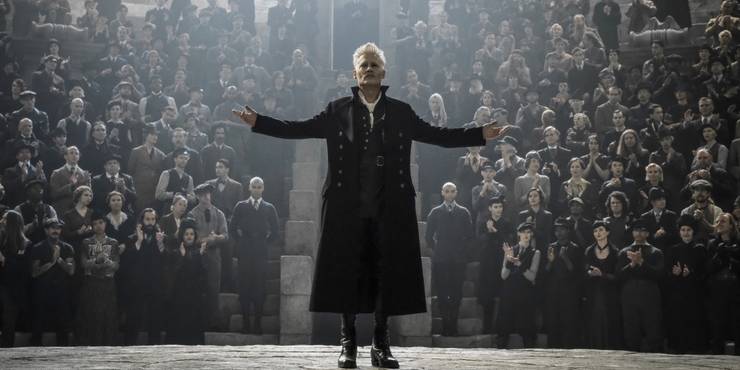 |
| Gellert Grindelwald's rally in Paris. Yes, that is Johnny Depp in the role of where his character was to be known as the darkest known wizard in the wizarding world...until decades later of a certain Lord Voldermort. (Image via here.) |
 |
| From the pages of the unauthorised biography of Albus Dumbledore by the disgraced Daily Prophet journalist Rita Skeeter in the penultimate film of the Harry Potter series, the first hints of the relationship between Dumbledore and Gellert Grindelwald from their younger days. And the line that has come to define their original shared vision of the wizarding world in terms of wizards rule over Muggles 'for the greater good'. (Image via here.) |
There had been whispers and rumours of Ariana apart from how old she was when she died in terms of why she was being kept away from public view before killing her Muggle-born witch mother Kendra by mistake when she was just six. But it was the fallout of three Muggle boys who saw her performing magic and was attacked by them which led to the family moving to Godric's Hollow, given Percival Dumbledore, the pure-blood wizard father of Albus, Aberforth, and Ariana, had attacked the boys as a result and serving a life sentence in Azkaban and died there. What was for certain in the end is that it is Albus's family situation which led to his and Gellert's view of the wizarding world starting to divulge away from each other.
In the second Fantastic Beasts film, there is a mention to how Gellert and Albus are 'closer than brothers'. There used to be a brief stir when JK Rowling revealed at a fans forum that Dumbledore is gay, but it would have made sense when Jude Law's character as the younger version of Albus Dumbledore the Hogwarts professor and how he saw himself at the Mirror of Erised. And speaking of that...
The Mirror of Erised and what Dumbledore saw
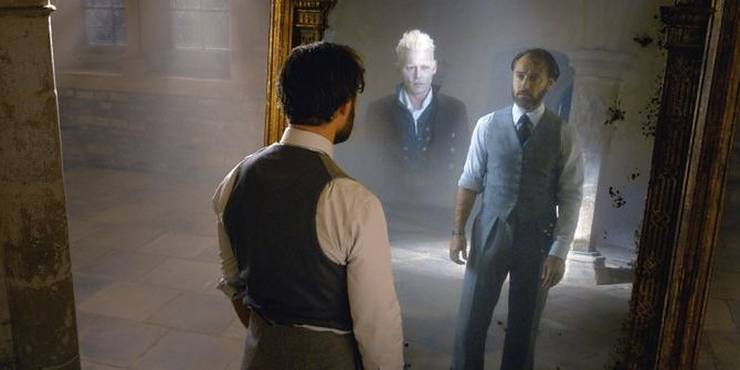 |
| The mirror which would have been a familiar sight for Harry Potter fans, a throwback to the first Harry Potter film where it last featured in the Mirror of Erised. This time in the second Fantastic Beasts film, Jude Law as the young Albus Dumbledore the Hogwarts professor, and how it was Gellert Grindelwald who reflected back at him. (Image via here.) |
Fantastic Beasts and Where to Find Them
 |
| The book that Newt Scamander will always be famous for. When the first film of the Fantastic Beasts series came out, the film title would not have been lost on Harry Potter fans of how this is one of the standard Hogwarts textbooks as well. (Image via here.) |
But then it was in the intervening times between the two Fantastic Beasts films, Newt's book was published and becoming popular in the wizarding world and a standard Hogwarts textbook in the process. It then turned out on the day the book was published in 1927 and he was doing his book signing, the wizarding celebrity magazine Spellbound (much like in the Muggle world, the most-commonly associated equivalent of 'Hello!' in the United Kingdom or 'People' in the United States) mistakenly wrote that he and his former Hogwarts classmate Leta Lestrange had been engaged. Because in actual fact, Leta's actual fiancé is Theseus Scamander, who is also Newt's older auror brother was also pictured at the book-signing.
 |
| The book launch of 'Fantastic Beasts & Where to Find Them' in 1927. It was after this event that the wizarding celebrity magazine Spellbound mistakenly wrote that Newt Scamander (second from left) has been engaged to his former Hogwarts classmate Leta Lestrange (second from right), where in actual fact she had been engaged to Newt's older brother, the auror Theseus (right). (Image via here.) |
When Zoe Kravitz was announced as Leta, it did make me wonder for a while if her character was in any way relating to the future members of the Lestrange family line, more famously in Bellatrix Lestrange whom was of course played brilliantly by Helena Bonham Carter in the Harry Potter films. Kravitz's character first appeared in the first Fantastic Beasts film as a photograph that Newt Scamander carried with him, until her backstory was revealed in the second film by her half-brother Yusuf Kama.
 |
| Zoe Kravitz as Leta Lestrange, when she was part of the delegation from the British Ministry of Magic meeting up with Albus Dumbledore at Hogwarts. She had wandered off and looking at her former desk at Hogwarts where it would later show scenes of her student days and her eventual friendship with Newt Scamander. (Image via here.) |
 |
| Before Leta Lestrange (in maroon) tells her story from her perspective, including how Credence Barebone could not have been her half-brother. (Image via here.) |
(The video edition of Leta Lestrange telling her story from her perspective, and the half-brother who could not have been Credence Barebone, whom her half-brother Yusuf Kama had mistakenly thought it was all along.)
The alchemist Nicholas Flamel
There is a reason why when Jacob Kowalski shook hands with Nicholas Flamel when both were introducing themselves, Flamel's hands was brittle. Flamel actually existed in history as a real-life person (though records wrote that he would live till he was in his 80s, has to be said), but in the world of Harry Potter where he was first mentioned in the first Potter book, he was the alchemist who worked alongside with Dumbledore in the creation of the Philosopher's Stone, or the Sorcerer's Stone in the American edition, lending itself to the title of the first Harry Potter book. Kowalski might had guessed Flamel's age wrongly, but it was certainly nice to see Flamel being depicted on the screen this time because he was only mentioned but never featured in the first Harry Potter film adaptation. Seeing Flamel on screen actually made me smiled and I nearly cheered for some reason in my head when he appeared, or maybe of how watching the first Potter film was to be what made me read the books...and the rest is history.
 |
| When Nicholas Flamel (left) and Jacob Kowalski (right) introduced themselves, as also seen in the second Fantastic Beasts film. There is also a real-life Flamel, but the version known in the world of Harry Potter and beyond is slightly different in terms of how he had worked with Albus Dumbledore on the creation of the Philosopher's Stone. (Image via here.) |
There was certainly a stir back when it was announced of South Korean actress Claudia Kim as Nagini, because Nagini has always being known as a snake loyal to Lord Voldermort. The second Fantastic Beasts film would come to explain through the person who kept Nagini at the circus of how she is a maledictus, an individual who suffers from a blood curse that is passed down from the female side of the family. Once the curse is struck, it will result in the individual turning into an animal permanently.
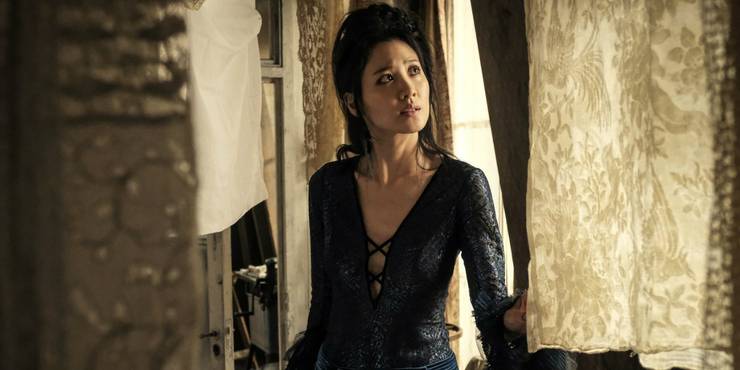 |
| South Korean actress Claudia Kim as Nagini in 'Fantastic Beasts: The Crimes of Grindelwald'. Back when the casting news was announced, it did caused a stir that she is actually a human being due to how in the world of Harry Potter, Nagini has always been known as a snake loyal to Lord Voldermort. So maybe the future Fantastic Beasts films may help to explain how it lead to that. (Image via here.) |
A younger Professor McGonagall at Hogwarts?
Maggie Smith will always be Minerva McGonagall in the world of Harry Potter films, the head of Gryffindor house and the Transfiguration professor, and eventually the Hogwarts headmistress after the Battle of Hogwarts. Her backstory might not had been fully explored even in the books, but still judging on what it might had been inferred from especially the fifth Harry Potter book when she was asked by Dolores Umbridge on how long she had been teaching at Hogwarts (it would have been the year 1995 when the book began, before ending in May 1996) where it will be 39 years 'by December' (which one can safely assume is December 1995), the closest one can assume is that she was born in 1935 and definitely a half-blood herself with having a Muggle father in the Scottish Presbyterian minister Robert McGonagall and a mother Isobel who is a witch, with the details on her parents being confirmed on the Wizarding World website. In the second Fantastic Beats film, the year is 1927. It is also noted on the Wizarding World website on her life that she only began teaching at Hogwarts two years after working at the Magical Law Enforcement department at the Ministry of Magic after graduating from Hogwarts, and if it stands up according to estimates, she attended Hogwarts in 1947 and returned as the Transfiguration professor in December 1956.
The mention of a 'Professor McGonagall' by the young Albus Dumbledore in the second Fantastic Beasts film certainly raised eyebrows. Because everything does not add up, and even if one want to throw in the possible theory that it could be Minerva's mother Isobel, it would also contradict what is written of the future Transfiguration professor's life on the Wizarding World website as well. Her mother stopped practising magic when she got married to Minerva's father, and it was only much later her mother revealed everything to her father on who she really is.
The Polyjuice Potion experiment that almost backfired
The second Fantastic Beasts film began with how apart from Gellert Grindelwald had to be sent back to Europe to be tried for his crimes from the United States before his eventual escape along the way, there was also Newt Scamander trying to get his international travel ban lifted after the events in the first film. It did not go to plan, and after he found out Tina Goldstein is in France from a postcard after Tina's sister Queenie and Jacob arrived in Britain and caught up with Newt in his apartment, something had to be done, even if his real reason to be in France was on the orders of Albus Dumbledore in terms of dealing with Credence Barebone. Through the method of using a Portkey (famously first referenced and used in the fourth Harry Potter book and film) with Jacob coming along after Queenie had already left for France to track down her sister. While Newt did eventually track Tina down in Paris, it was the investigation into Credence Barebone's identity which led the two into the French Ministry of Magic which may or may not hold the records.
Newt's efforts to find Tina Goldstein revealed more than intended. pic.twitter.com/q8ACamS2mg— Fantastic Beasts (@FantasticBeasts) May 24, 2020
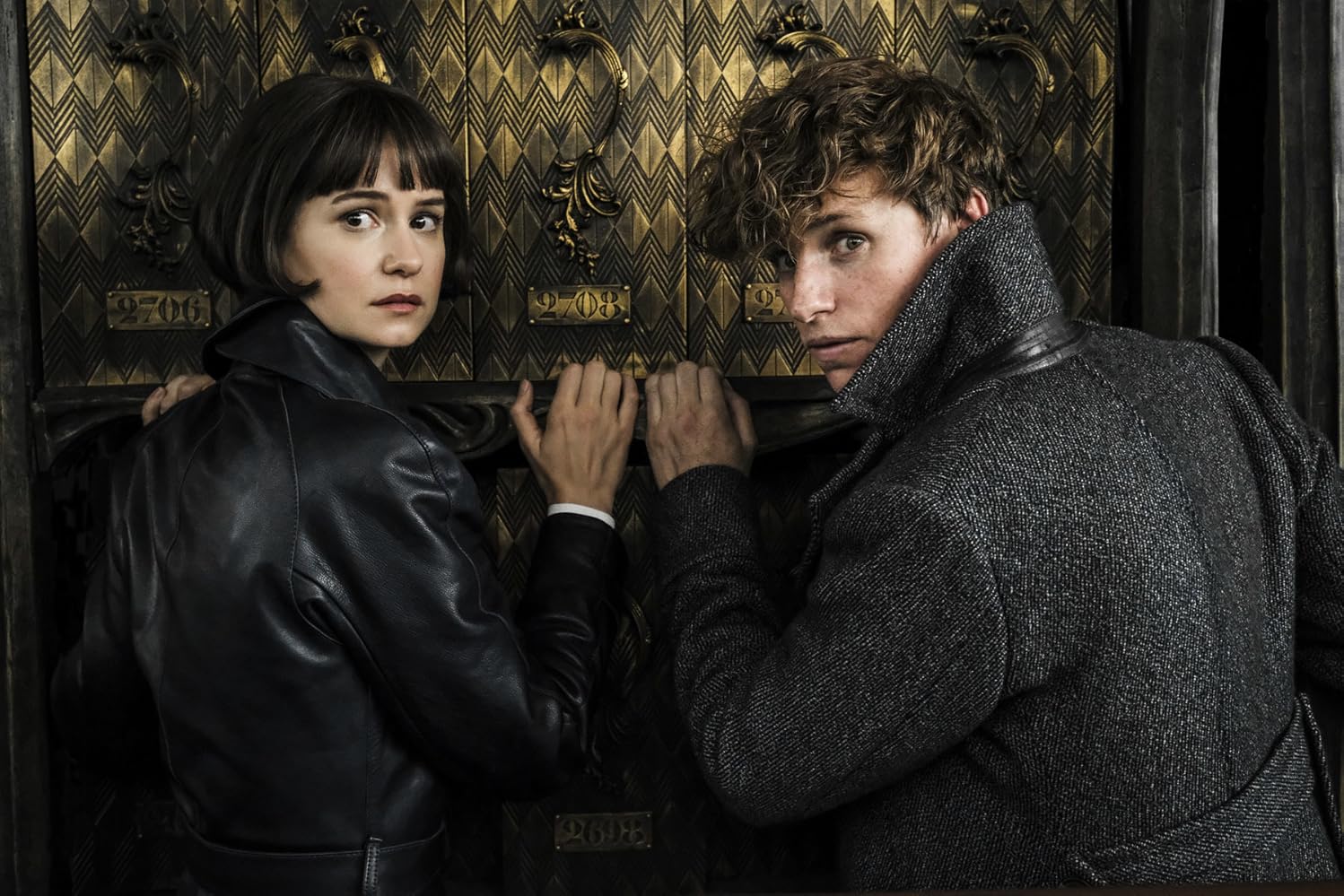 |
| The infiltration into the French Ministry of Magic, searching into the records of Credence Barebone's identity...until Newt Scamander (right) was being found out and had to escape along with Tina Goldstein (right). (Image via here.) |
 |
| What happened after Newt Scamander drank the Polyjuice Potion before the infiltration into the French Ministry of Magic with Tina Goldstein. Yes, turning into his older auror brother Theseus. (Image via here.) |
Albus Dumbledore as the Defence Against the Dark Arts professor?
Lessons in Defence Against the Dark Arts at Hogwarts tend to get its space especially in the Harry Potter books and films, or maybe it is due to the different professors that taught the subject in each of the year Harry was at Hogwarts. Except for the seventh year where Harry was not attending Hogwarts, each year always bring something new to the classroom. What was featured in the second Fantastic Beasts film would lead to reminders of what happened in the third Harry Potter book and film of the iconic boggart class and Remus Lupin teaching the students of how to counter the boggart.
(The boggart class with Professor Albus Dumbledore's guidance during the Defence Against the Dark Arts. Leta Lestrange's boggart actually came in the shape of her half-brother whom was drowned while they were on the way to the United States when she was much younger. Newt's boggart is perfectly understandable in hindsight. Though with Dumbledore teaching this at Hogwarts is curious, given it has always been made known that he taught Transfiguration before becoming the headmaster.)
And there is the young Albus Dumbledore teaching that. But it has always been known before he became the Hogwarts headmaster, his last teaching subject was in Transfiguration until Minerva McGonagall succeeded him in that position. Unless Jude Law's character was standing in for another professor, no one knows why his character was there in the first place.
The phoenix and the Dumbledore family legend
When Albus Dumbledore first met Newt Scamander in London, apart from telling him what was the real reason for the latter to be in the United States as referenced in the events in the first Fantastic Beasts film in terms of where he was meant to be releasing a thunderbird in Arizona and sending him on another mission but to France (in terms of tracking down Credence Barebone), he also spoke of a family legend in the form of how a phoenix will always appear to a Dumbledore in time of need. It would lead to reminders to the older Dumbledore and his phoenix Fawkes in the headmaster office where one was first acquainted with that in the second Harry Potter book and the film. And of course the fifth Harry Potter book was also titled 'Harry Potter & The Order of the Phoenix', a nod to the group founded during the first rise of Lord Voldermort to counter him and his followers, originally led by Dumbledore (until what happened to him in the sixth Potter book and film).
(Jude Law on playing the younger version of Albus Dumbledore, along with JK Rowling's thoughts on the future Hogwarts headmaster and how in 'Fantastic Beasts: The Crimes of Grindelwald', it is mainly seen through Newt Scamander's perspective.)
There is also the case of what happened when Gellert Grindelwald and Credence Barebone were at Grindelwald's headquarters in Nurmengard in Austria, after Credence spotted Grindelwald at the latter's rally in Paris. Grindelwald claiming that Credence is actually Aurelius Dumbledore, which would mean that he may be actually related to Albus. Or is he? This would definitely mess up the Dumbledore family tree as it was to be established in the final Harry Potter book when apart from Aberforth whom had already been introduced before the final Harry Potter book, the rest of Albus's family were introduced in the final Potter book of the series, also as a way to tell his backstory and his relationship with Grindelwald.
